

AI can do a remarkable amount of bookkeeping work, but letting it write directly to a client’s general ledger introduces risks that are expensive to unwind. The safer design is for AI to prepare entries and an accountant to approve them before they post.
The Short Answer
Letting AI post directly to the general ledger is risky because AI can be confidently wrong, errors repeat at scale, automated changes weaken the audit trail, and write access can be manipulated. The safest approach is human-in-the-loop bookkeeping: AI prepares categorizations and journal entries, and an accountant reviews and approves them before they post.
Six Risks of AI Writing Directly to the Ledger
Six things can go wrong when AI writes to the ledger without review.
1. AI Can Be Confidently Wrong
AI models can produce answers that look right but aren’t, a failure known as hallucination. In accounting, that means a plausible but wrong category, a vendor matched to the wrong transaction, an amount misread from a document, or a journal entry that balances but shouldn’t exist. Accountants know this: in Financial Cents’ 2026 survey, 38% of open-ended answers about professionals’ biggest AI worry raised confident-but-wrong output, and only 19% of those at firms using AI trusted its output enough to use it with limited review.
2. Errors Compound at Scale
A person’s mistake usually affects one entry. An automated mistake repeats across every similar transaction and every client file until someone notices, flowing into reconciliations, financial statements, lender reports and tax returns.
3. The Ledger Is a Record of Record
Books are meant to be a reliable, traceable history of what was recorded, when, by whom and why. When AI edits or reclassifies entries on its own, especially in closed or reported periods, it gets harder to show who changed what, and numbers already delivered to clients can shift underneath them.
4. Write Access Is an Attack Surface
Any system that can write to a ledger is a target. AI agents add new risks, such as instructions hidden in an invoice, email or memo field that try to steer the AI (prompt injection), or stolen credentials used to push entries that disguise fraud.
5. Accountability Stays with Your Firm
Professional standards and client engagement letters hold the firm responsible for the books, not the software vendor. “The AI posted it” is not a defense with a client, an auditor or a regulator.
6. Judgment Still Needs People
How to treat an unusual transaction, what a client intended, which tax position to take: AI can surface these and suggest an answer, but an accountant should decide.
Where Automation Already Posts Without Review
This isn’t hypothetical. QuickBooks bank rules, for example, can be set to auto-post matching transactions without anyone reviewing them. Firms should know which automations are active for each client.
Controls That Keep a Human in the Loop
| Control | Why it matters | How Ensi handles it |
| Approval before posting | Catches errors before they reach the books | Every entry approved by your team |
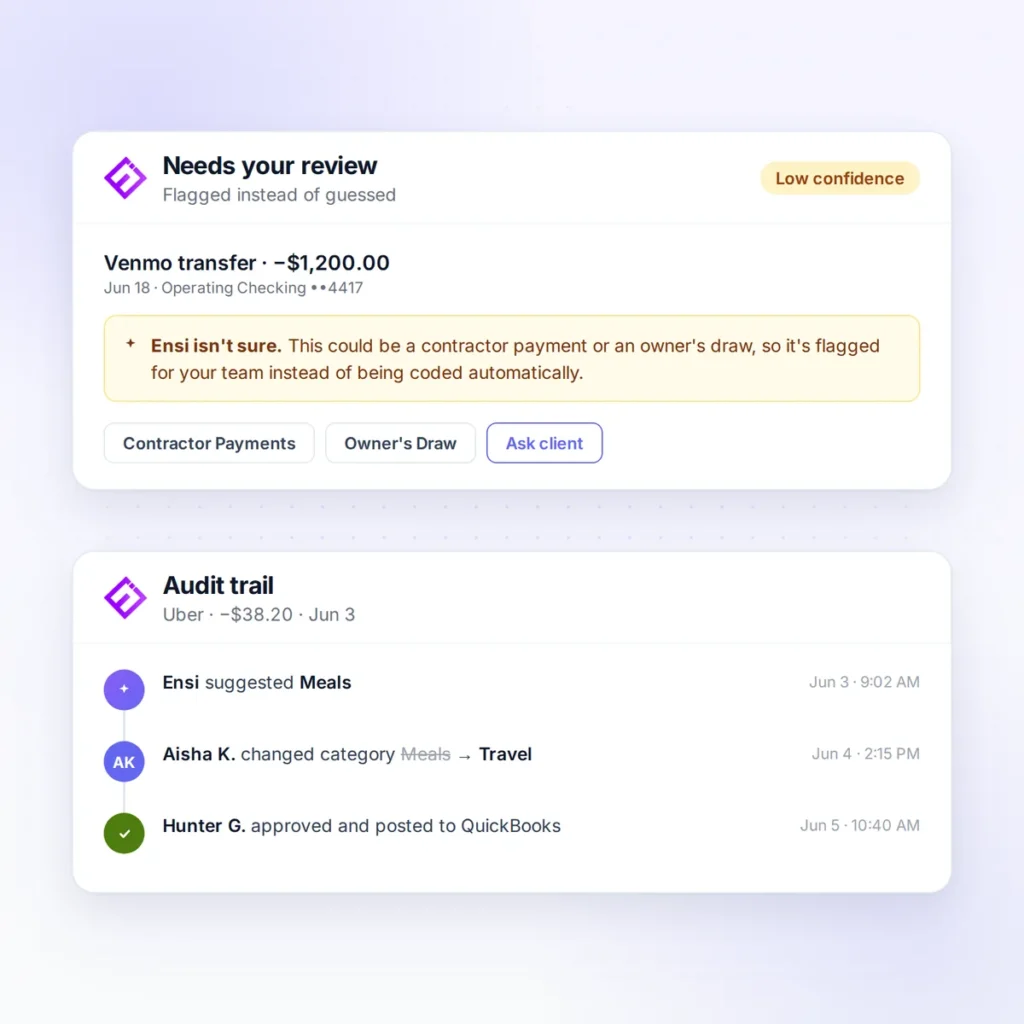
| Uncertainty flagged | AI shouldn’t guess on low-confidence items | Uncertain items routed to a person |
| Change log | Shows who approved what and when | Every adjustment keeps an audit trail |
| Ledger stays system of record | No shadow copy of the books | QBO remains the system of record |
| Ongoing checks | Catches what slips through review | Every ledger checked for anomalies and missing transactions |
| Access control | Limits exposure if something goes wrong | Disconnect any client with one click; SOC 2 audit underway |
How Ensi Is Designed: AI Prepares, Accountants Approve
Ensi is built on one rule: the AI does the work, and a person decides what goes into the books. You get the speed of automation without handing the AI the pen.
Uncertain Items Are Flagged, Not Guessed
Anything Ensi isn’t sure about comes to your team for a decision.
Your Team Approves Every Entry
Nothing posts to a client’s books without sign-off, and every adjustment keeps an audit trail.
Review Is Standardized
Checklists, exception lists and suggested corrections let staff clear most issues before manager or partner sign-off.
QuickBooks Stays the System of Record
Approved entries post back to QuickBooks Online; client books never live anywhere else.
You Control Access
Ensi was built by a security-first team, its SOC 2 audit is underway, and you can disconnect any client with one click.
See every Ensi use case.
Questions to Ask Before AI Posts to Your Ledger
- Can the AI post or change entries without approval, including in closed periods?
- What happens to transactions the AI isn’t sure about?
- How do we see who approved each entry, and when?
- What stops a manipulated document or stolen login from steering the AI?
- Where do our clients’ books live, and how do we leave?
Frequently Asked Questions
Is it safe to let AI post directly to the general ledger?
Not without review. AI can make confident mistakes, repeat errors across many transactions and clients, weaken the audit trail, and be manipulated through documents or stolen credentials. The safer design is for AI to prepare entries and an accountant to approve them. Ensi works this way.
What is human-in-the-loop bookkeeping?
Human-in-the-loop bookkeeping means AI prepares the work, such as categorizations, reconciliations and journal entries, and a person reviews and approves it before anything posts to the books.
What is an AI hallucination in accounting?
It’s when AI produces output that looks correct but isn’t, such as a plausible but wrong account, a misread amount or an entry that shouldn’t exist. Review before posting is the main safeguard.
What is prompt injection, and why does it matter for bookkeeping?
Prompt injection is when instructions hidden in content the AI reads, such as an invoice, email or memo field, try to steer what it does. If an AI can post to the ledger on its own, a manipulated document could change the books.
Does Ensi ever post without approval?
No. Ensi prepares entries and your team approves them before they post to QuickBooks Online. Uncertain items are flagged, and every adjustment keeps an audit trail.
Does Ensi work with QuickBooks Online?
Yes. Ensi reads from QuickBooks Online, your team reviews the proposed work, and approved entries post back to QBO. QuickBooks stays the system of record.
Is client data secure with Ensi?
Ensi’s founders come from data-security backgrounds, and its SOC 2 audit is underway. Client books stay in QuickBooks Online, and you can revoke Ensi’s access to any client with one click.
See Human-in-the-Loop AI on Your Own Client File
Bring a client file to a 30-minute demo and watch Ensi prepare the work while your team stays in control, with no slides.