


How Rules-Based Tools Are Costing Your CPA Firm Growth
Many CPAs mistakenly believe they have automated scalable workflows, when in reality, they have simply implemented complex rules that are hindering their firm’s ability to scale. While traditional rules-based automation has benefits, forward-thinking CPA firms are increasingly transitioning to Artificial Intelligence (AI) to unlock growth.
The Linear Trap of Traditional Rules-Based Automation
Traditional accounting automation is fundamentally limited by its reliance on deterministic “If/Then” logic. For example, a rule might state, “If an invoice contains the text ‘Microsoft’, then code it to the IT expense account.”
While this works in a controlled environment, it fails with scale because real-world data is messy. Vendors update templates, banks change transaction descriptions, and client situations change. Every time the input data deviates from the rule, automation breaks, triggering an exception that requires manual staff intervention.
For growing firms, this results in “Rule Debt.” Instead of spending time on value-add accounting, your team is buried in maintenance overhead, managing a growing number of rules and constantly “babysitting” the software. This can also apply to your review process if it is primarily based on rules (e.g., “review any journal entry related to payroll”). As you increase your clients, complexity also increases, adding to the maintenance burden. You cannot keep rules up to date and have to choose which things to update/review given limited time. Consequently, traditional automation forces growth to remain linear; your efficiency hits a plateau, effectively capping your firm’s growth.
AI is Changing the Game
AI Automation is fundamentally different. It is not based on rules you create — instead the AI is given instructions to review the ENTIRE ledger and look for anomalies. How it finds those anomalies can vary by task and data. For example, transaction coding anomalies are found one way while reconciliation mis-matches and errors in journal entries are completely different problems. They key, though, is that this automation scales via data and usage, not via human input of rules. The difference in growth between these two approaches is captured in the comparison chart provided below. This visual analysis contrasts the growth trajectories of a firm relying on traditional methods versus leveraging AI.
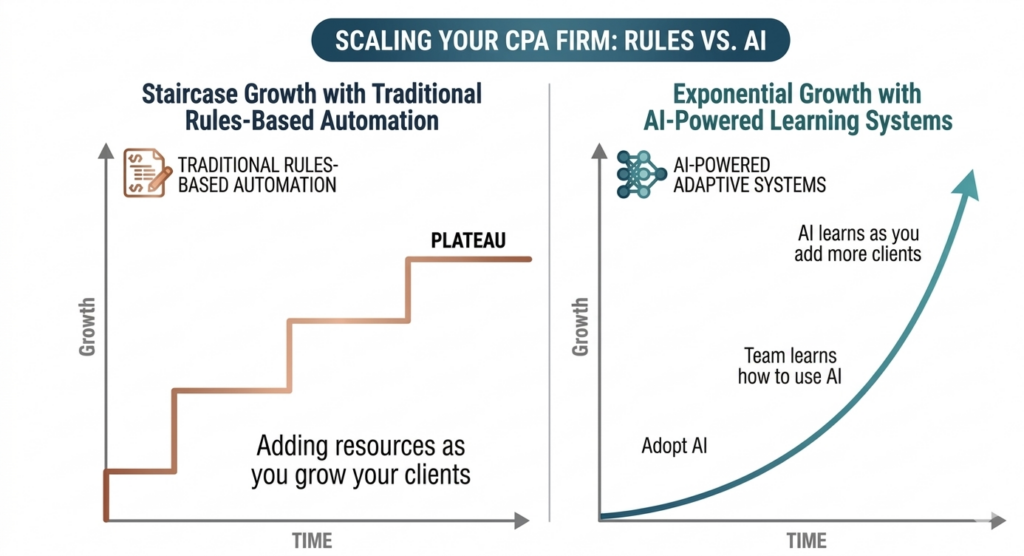
Staircase Growth (Traditional Automation): This illustrates the problem where growth requires a parallel increase in resources. The added overhead of Rule Debt—managing an increasing amount of rules as you add more clients—creates a staircase that inevitably reaches a plateau.
Exponential Growth (AI-Powered Learning): AI transforms accounting into a self-optimizing ecosystem. Unlike rigid rules that stay static, AI uses probabilistic models to learn from every transaction. This creates a compounding accuracy loop: as you add more clients and data, the system processes a wider variety of scenarios, refining its understanding and reducing errors automatically. By continuously adapting to real-time data, AI eliminates “Rule Debt” and allows your firm’s capabilities to scale.
AI doesn’t just process data; it understands it in its own powerful way. Current AI systems have limited “judgement” capabilities but can easily review infinitely more data than a human. AI-powered systems can analyze data patterns to:
- Understand Context: Understand why certain transactions/journal entries/adjustments exist and identify any mistakes.
- Interpret Structure: Accurately extract data from documents regardless of its format or layout changes.
- Learn Patterns: Continuously improve by analyzing how your specific firm processes unique or complex transaction scenarios.
This ability to effectively manage data context at scale allows firms to decouple headcount from revenue growth, freeing your staff to focus on high-value work.
Table 1: Key Differences Between Approaches
| Traditional Rules-Based Automation | AI-Powered Learning Systems | |
| Logic | Rigid: follows predefined scripts. | Adaptive: continuously learns from new data patterns. |
| Effort | High Maintenance: requires constant manual updates. | Self-Optimizing: gets better and more accurate over time. |
| Stability | Breaks: when data patterns or formats change. | Resilient: interprets context variations to prevent exceptions. |
| Scale | Limited: requires incremental resources for incremental growth | Exponential: AI learns and gets better as you grow. |
The Bottom Line
While traditional rules-based tools have long been the standard, relying on them for scalable growth has been limiting. The transition to intelligent, adaptive AI learning systems represents a fundamental shift in accounting practice. Embracing technology that enables context-aware, learning-based systems allows growth-minded CPA firms to unlock growth at scale.
Want to learn more about what is possible with Accounting AI? Let us show you real-world examples — book a meeting with us.