

By Mo Sajid · May 2026 · 5 min read
The promise of AI in accounting is real. But there’s a growing gap between general-purpose automation tools and software designed for accounting workflows — and that gap has serious consequences for scalability, auditability, and the bottom line.
Claude Cowork is impressive technology. It gives anyone the ability to point AI at their local files, describe a task in plain English, and watch Cowork execute it autonomously. For busy professionals trying to automate repetitive work, it’s a breakthrough that will change how a broad range of work gets done.
It makes sense that accounting and finance teams are experimenting with it. Reconciliations, expense categorization, invoice processing, and journal entry drafts are the kinds of high-effort, repetitive tasks that Cowork can assist with. We tried using it for various workflows and it is fairly impressive; we can see the value when you need to automate something in a pinch, for a one-time data cleanup or for a solo bookkeeper.
But ‘can do it’ and ‘built for it’ are very different things. This post describes our initial findings on what Cowork actually is, where it works and where it breaks down when applied to accounting workflows. We wanted to see how it compares to AI-native software designed specifically for accounting workflows. We understand that Cowork’s capabilities will evolve with time and we wanted to mention that this blog is an attempt at capturing our thoughts today and inevitably we will likely expand on this discussion in the near future.
What Claude Cowork Actually Is
Cowork is Anthropic’s desktop automation agent — described by Anthropic itself as ‘Claude Code for everyone else.’ It connects to your local files and applications and can autonomously execute multi-step tasks you describe in natural language. It’s powerful, accessible, and genuinely useful for a wide range of knowledge work.
Cowork’s accounting-adjacent use cases include extracting purchase info from receipts and emails, organizing expense data across sources, filling in spreadsheets from multiple inputs, and drafting structured reports from document sets. For individual contributors doing ad-hoc data work, these are real productivity wins.
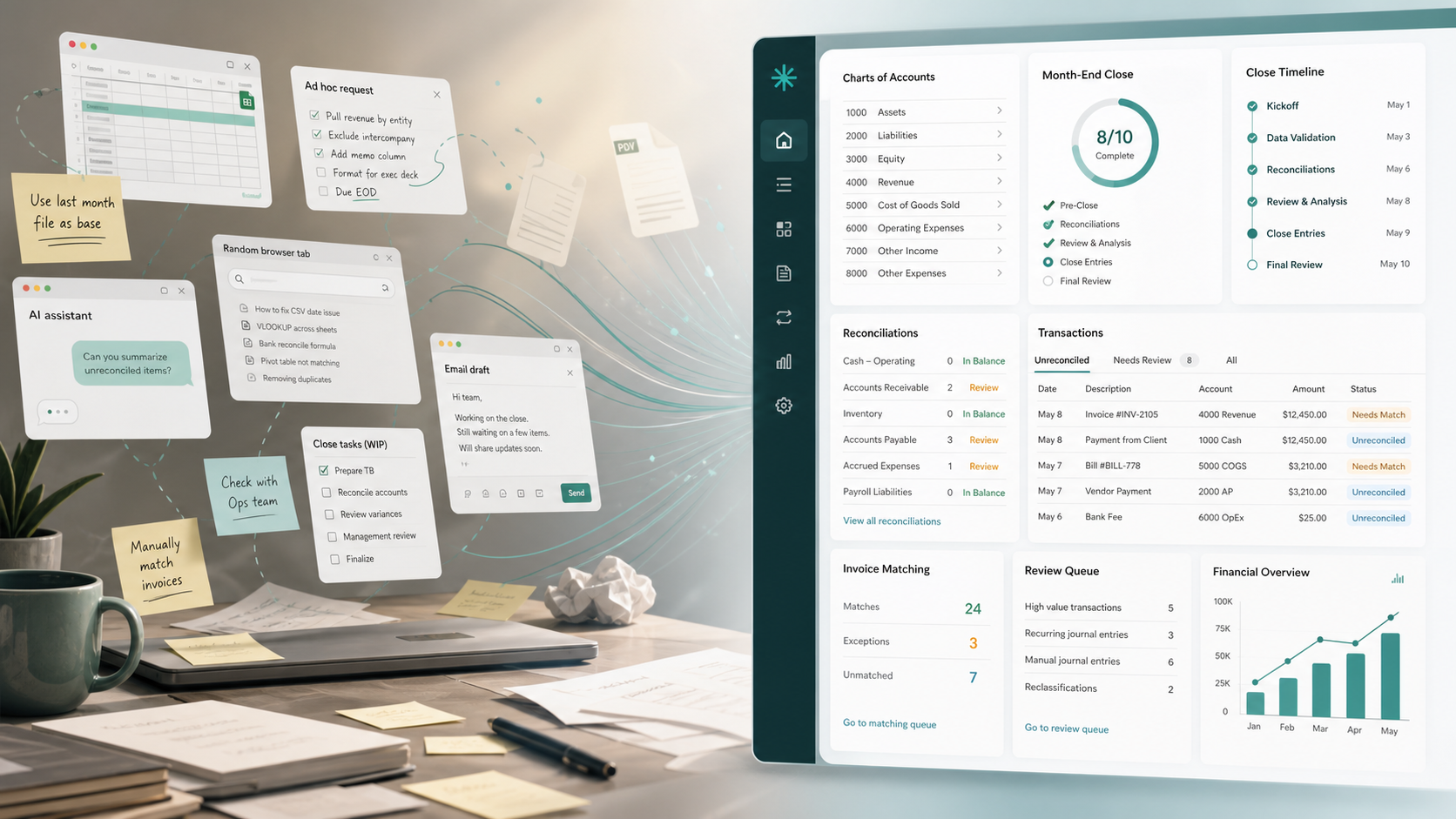
The critical architectural detail: Cowork is a general-purpose desktop agent; think swiss army knife. It has no accounting-specific data model, no chart-of-accounts awareness, no GAAP or IFRS compliance logic, no integration with your general ledger, and no built-in audit trail. It is, by design, a flexible blank slate. And that’s precisely the problem.
Where Cowork Falls Short
1. It Requires Constant Prompt Engineering
Every meaningful task in Cowork starts with a prompt. Want to categorize expenses by GL code? You need to write that logic into the prompt — including the category taxonomy, the edge-case handling, the output format. Want to process vendor invoices? You need to instruct Claude on what to extract, how to handle duplicates, what to do with missing fields.
This means someone on your team is effectively writing and maintaining a set of informal ‘accounting instructions’ inside natural language prompts. Those prompts need to be updated whenever policy changes, whenever a new vendor is onboarded, whenever an account structure is revised. This is what we call “Rule-Debt”. Rule-Debt is overhead that requires on-going maintenance anytime something changes. AI automation is supposed to learn over time; this is prompt engineering that is using AI to run Rules based automation. This looks as much like manual process management as it does AI automation.
“Configure recurring tasks in Cowork — daily briefings, weekly reports, automated file processing.” — Anthropic documentation. What’s not mentioned: someone has to write and maintain every one of those task configurations manually. Writing it once is doable; not updating it for months will cause problems.
2. It Is Not Scalable
Cowork runs on a single desktop. It requires a desktop app to be open and the computer to be awake. Scheduled tasks don’t execute if the machine is off. There is no concept of multi-user workflows, client segregation, or role-based access control suited to a multi-entity accounting practice.
Cowork’s documentation is explicit about this: ‘Sessions cannot be shared with others.’ For a sole practitioner experimenting with automation, this is manageable. For an accounting firm managing dozens of clients, or a finance department running month-end close across multiple entities, this is a fundamental structural limitation. Cowork does not scale to the firm.
· No multi-user or team-level task coordination
· No client or entity segregation built in
· Scheduled tasks require a specific machine to be awake and running
· Heavy task usage rapidly consumes per-user subscription limits, leading to higher costs.
· No centralized administration across a practice
3. It Has No Meaningful Audit Trail
Auditability is not optional in accounting. Every journal entry, every reconciliation, every categorization decision needs to be traceable — who did it, when, why, and based on what data. This is not just a best practice; it is a legal requirement.
Cowork shows progress indicators and surfaces reasoning as Claude works, but it does not produce a structured, audit log of decisions made. When a Claude session ends, the step-by-step reasoning it used to categorize 300 transactions does not persist in a queryable, exportable, compliance-ready format. If an auditor asks ‘why was this transaction coded to this account,’ the answer is not available in any structured way.
Furthermore, Anthropic’s own guidance notes that sensitive financial data should be handled carefully within Cowork, and that the computer use feature in particular should not be enabled for regulated financial workloads. That is a significant caveat for any firm operating under GAAP, SOX, or PCAOB requirements.
Audit logs can be created as part of the workflow. This would not be native but instead a rule based operation that would add a significant amount of Rule-Debt. The exception handling would increase as you try to scale with more clients or larger clients.
4. Maintenance Overhead Accumulates Quietly
The true cost of Cowork-based accounting automation is not the subscription fee — it’s the ongoing human time required to maintain it. Every prompt is a policy document that needs governance. When your firm’s expense categorization rules change, someone must find and update every related Cowork task configuration. When Claude interprets a transaction incorrectly, someone must diagnose whether the problem is the prompt, the data, or the model — and rewrite accordingly.
This overhead is invisible at first. But as task complexity grows and as the number of automated workflows expands, the maintenance burden begins to rival the time savings. The automation workflows will require dedicated administrators who will burn more and more cycles as your firm grows.
AI-Native Accounting Software Is Different
AI-native accounting software is not a general-purpose agent bolted onto a file system. It is software built from the ground up around the accounting workflow, the compliance logic, the auditability, and the scalability architecture designed-in from day one.
Designed Around the Accounting Data Model
An AI-native accounting platform understands double-entry bookkeeping, chart-of-accounts structures, period-end close cycles, and the semantic difference between an accrual and a deferral. It doesn’t need to be told what a GL code is. It doesn’t require a prompt to understand that a vendor credit note has different accounting treatment than a standard invoice. That knowledge is embedded in the platform.
This means the AI can make genuinely intelligent decisions without needing a human to write accounting rules into natural language prompts every time. The accounting logic is the product — not a configuration responsibility offloaded to the user.
Built-In Auditability
Every action taken by an AI-native accounting system is logged in a structured, immutable, queryable audit trail. Every transaction classification, every journal entry suggestion, every reconciliation match carries with it: the input data that triggered it, the model’s reasoning, the timestamp, and the user who approved it. This is not a feature — it is a prerequisite. AI-native accounting software treats auditability as a first-class architectural requirement.
When your external auditor asks for documentation of automated journal entries, an AI-native platform can produce a complete, structured export. Cowork cannot.
Scalable Across Clients, Entities, and Teams
AI-native software runs in the cloud, supports multi-user role-based access, maintains strict entity and client segregation, and scales horizontally as your firm or organization grows. Onboarding a new client doesn’t require duplicating a set of prompts on a new machine — it requires adding an entity to a platform that already understands how to handle it.
Workflows are defined once, governed centrally, and executed consistently across every client and entity in your portfolio. Quality control is a platform feature, not a manual review step.
Lower Total Cost of Ownership
The counterintuitive truth about AI-native software is that even if the headline subscription cost is higher than a Claude Cowork plan(which it might not be), the total cost of ownership is lower — because the hidden costs of Cowork (prompt engineering time, maintenance overhead, error remediation, compliance gaps) are eliminated. You pay for a platform that does the work. You don’t pay a platform and then also pay a team to maintain it.
At a Glance: Cowork vs. AI-Native Accounting Software
The table below summarizes the key dimensions.
| Dimension | Claude Cowork | AI-Native |
| Design Intent | Desktop automation | Built for accounting workflows |
| Accounting Knowledge | General-Purspose | Embedded in the data model |
| Auditability | No structured audit trail | Immutable, queryable audit log |
| Scalability | Single-user, single machine | Multi-user, cloud-native |
| Prompt Maintenance | High — ongoing Rule-Debt | None |
| Error Traceability | Difficult — session reasoning lost | Full reasoning log per transaction |
| Total Cost of Ownership | Low subscription, high hidden cost | low subscription, low hidden cost |
The Bottom Line
Claude Cowork is a genuinely impressive general-purpose tool, and we have no doubt that curious accountants and bookkeepers will continue to find creative uses for it. Anthropic has built something meaningful for knowledge workers.
But meaningful is not the same as purpose-built. Accounting is a discipline with deep logic, strict compliance requirements, and significant consequences for error. Automating it properly requires software that understands accounting workflows — not software that can be instructed to approximate it through carefully maintained prompts.
The question isn’t whether AI can help with accounting. It can. The question is whether you want AI that has to be taught your accounting rules every time — or AI that already knows them.
At Ensi, we built our platform specifically for accounting and bookkeeping workflows — with the data model, the compliance logic, the audit trail, and the scalability architecture that professional accounting demands. Not as a workaround. As the product.
If you’re evaluating AI for your accounting practice and want to see what purpose-built looks like, we’d love to show you. Visit ensi.ai to request a demo.