

The Monthly Sprint is Costing Your Firm
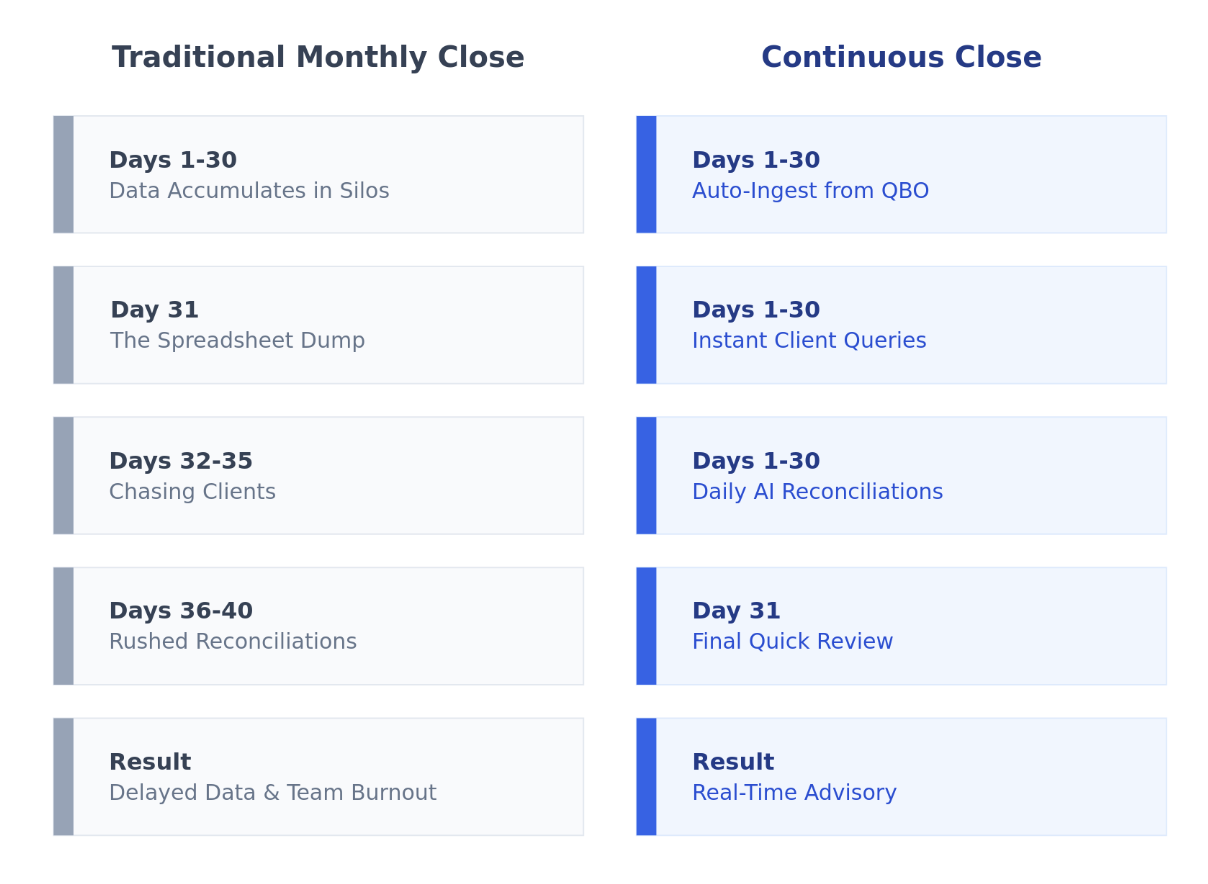
For generations, the monthly close has dictated the schedule of the accounting industry. It forces firms into a predictable but punishing cycle: wait 30 days, collect the data, and then scramble to reconcile an entire month of financial activity in just a few days. This batch-processing model is structurally flawed for modern firms.
When you pack weeks of work into a tiny window, three things happen. First, your clients receive historical data rather than actionable, real-time insights. Second, the sheer volume of rushed reconciliations inevitably leads to manual errors and late-stage adjustments. Finally, the chronic stress of this end-of-month panic burns out talented staff who expect modern, efficient processes. The traditional monthly close is no longer just an inconvenience; it is an active barrier to scaling your practice.
The Uncategorized Transaction Trap
The most glaring failure of the traditional close is how it handles uncategorized expenses. Under the monthly model, accountants are forced to wait until the period ends to download reports, highlight the mystery transactions, and email a massive spreadsheet to the client.
This creates a massive bottleneck. The biggest drain on a firm’s realization rate is not the accounting itself, but the endless waiting game for client replies. By the time a client reviews a list of vendor charges from three weeks prior, their memory has faded, leading to vague answers and misclassified expenses. It essentially forces highly trained CPAs to act as administrative assistants, sending endless follow-up emails just to close the books. A single unresponsive client can derail your firm’s entire reporting timeline.
The Logic of the Continuous Close
A continuous close completely flips this dynamic by matching the pace of your accounting to the speed of the business. Instead of letting data pile up for 30 days, a continuous close distributes the workload evenly, managing journal entries and bank feeds as they happen.
By leveraging modern workflows, transactions are ingested and sorted daily. When a mystery expense does occur, the system can flag it and query the client immediately, while the context of the purchase is still entirely fresh in their mind. By the time the calendar actually flips to the new month, the heavy lifting is already complete. Your team simply reviews the finalized numbers, transforming a chaotic multi-day sprint into a calm, standardized routine.
Powering the Shift in QuickBooks Online
You cannot achieve a continuous close simply by asking your team to work faster in the same old spreadsheets. Moving to a real-time model requires purpose-built automation that integrates directly into the ledger your clients already use. For the vast majority of small CPA firms, that means deep, seamless integration with QuickBooks Online.
By adopting AI-driven tools that operate directly within the QBO ecosystem, small firms can automate the tedious categorization of routine transactions and instantly standardize their workflows across their entire client base. The technology required to eliminate the end-of-month scramble is already here. The only question is whether your firm will continue looking backward next month, or start operating in real-time.
At ENSI.ai, we build AI-native workflows designed specifically to help small CPA firms automate SMB bookkeeping directly inside QuickBooks Online. Ready to eliminate the month-end bottleneck? Let’s talk.